
You will have to contact Environmental Health for more information on your sewer or septic system. Their phone number is 608-242-6515 and their address is 2300 S. Park St.
Building permits may be obtained at the local municipality. Here is a directory with contact information: https://clerk.countyofdane.com/directory.aspx
Driveway permits may be obtained at the local municipality. Here is a directory with contact information: https://clerk.countyofdane.com/directory.aspx
Environmental Health (MDC), 2300 S Park St, Madison, WI 53713, 608-266-4821 https://www.publichealthmdc.com/environmental-health/licensing-permits/water-well-septic
Dane County Land and Water Resources, 5201 Fen Oak Dr Ste 208, Madison, WI 53718, 608-224-3730
https://wred-lwrd.countyofdane.com/permitting/erosion-control
Our office is open from 7:45 am to 4:30 pm Monday - Friday. Permits are issued 8 am to 4 pm. Applications made after 4 pm will be processed the following business day.
Dane County Zoning will investigate potential violations and complaints that are submitted in writing to our department. Please send complaints via e-mail or mail to:
Dane County Zoning
210 Martin Luther King Jr. Blvd Rm 116
Madison WI 53703
We currently only accept cash or check, however we are developing the ability to accept online payments using credit or debit cards.
The County Surveyor's Office does not provide field services. You can have your property surveyed by hiring a private sector licensed land surveyor. If a survey of your property has previously been recorded you can retrieve a copy of the survey from the Surveyor's office.
Yes, you can email your application to zoning@countyofdane.com but do keep in mind that if you email it in and are missing any additional information, it could delay the process.
Instructions on how to use AccessDane to find the zoning of your property can be found here.
No. Dane County Zoning only has jurisdiction for the rural areas of the County. If you are within a City or Village you should contact the City or Village directly for all permitting requirements.
Yes. Please mail a copy of your application and associated plans to:
Dane County Zoning
210 Martin Luther King Jr. Blvd Rm 116
Madison WI 53703
Fees are payable to Dane County Zoning
For zoning questions about your property you have two options:
Each Town in Dane County has it's own set of development rules. Contact the Dane County planner that is familiar with the Town you live in and we can walk you through the process. Most likely you will have to go throug the Density Study process to get a handle how many homes can be built on your property.
Our office is required to list the owners of real estate according to the recorded documents in the Register of Deeds office. If there was no type of documentation to change the ownership in the property (quit claim deed, divorce judgment, etc.) we do not have any way of changing the names. In this case, you may wish to check with the attorney handling the divorce about transferring the property.
It depends on how the title to the property was held. If the property was held in joint tenancy or survivorship marital property, you can file a Termination of Decedent’s Interest form with the Register of Deeds office. This form is available at the Register of Deeds office and the staff can provide you with instructions on filling out the form. If the property was not titled this way, you may wish to contact an attorney to help transfer the property, especially if the property needs to go through probate.
If you haven’t recorded any document to transfer the title to your property since your marriage, the name reflected on the tax bill and assessment notice will be the same as listed on the conveyance where you took title. To change the ownership, you may contact an attorney to prepare the documents. Or, if you feel comfortable doing it yourself, you may download the deed forms from the link provided on the Register of Deeds website Click on the link under Real Estate labeled Deeds.
Our office is required to maintain the values established by the assessor for your municipality. If you do not agree with your values, you should first contact your assessor to discuss it. A good source of information is the state Department of Revenue website which contains information on property owners' rights and information about the assessment process.
The Dane County Surveyor’s office has copies of plats and property surveys. To contact that office, call 266-4253.
Dane County Zoning has information on zoning for properties in rural Dane County. You may also try checking the Access Dane website. If the property is located within an incorporated city or village, you will need to contact the appropriate department in that municipality.
For first installment amounts, you should check with the treasurer for your municipality. After that, check with the Dane County Treasurer’s office at 266-4151.
If you would like the properties to be assessed together, you may contact the assessor for your municipality. If the properties are assessed together, you will get one assessment notice and one tax bill, but the properties will continue to be listed individually in the assessment roll. If you want the real estate parcels combined to create one assessment parcel, please contact our office so we may review the parcels. Sometimes, due to taxing district boundaries, such as school or tif districts, we are not able to combine parcels for taxpayers.
When new lots, or parcels are created during the year, new parcel numbers are assigned. However, assessments are based on how the property existed on January 1 of the given year. If a parcel is split during the year, the tax bill will go out as a whole to the person who owned it when it was split. The new parcels will not be assessed or taxed until the following year. If you would like the tax bill split, contact the treasurer for your municipality. Under certain circumstances they may split the tax bill for you.
Tax bills are generated for a property as it existed as of January 1st of that tax year.
If the property is split and new tax parcels are created and sold during that tax year, those new tax parcels will not be assessed or taxed until the following year. Unless our office is notified to update the parent parcel (the current year tax parcel), the bills will be sent to the owner of the parcel prior to the split. In situations like this, property owners may request a split tax bill after the bills have been generated. Contact your local treasurer and request a split of the bill. Local treasurers will then work with the local assessor to determine the appropriate amount is prorated.
Yes we can. Use the Custom Map link here https://lio.countyofdane.com/services/custom-maps to request just such a map. Common requests might include: aerial photograph (current and historical), elevation and land use.
Yes you can. First check the Open Data Portal at the Land Information Office for data that you can download and use with select mapping software https://gis-countyofdane.opendata.arcgis.com/ . If you desire something custom (for example tax parcels with an improvement value above $100,000 in a specific census tract that are within 2 miles of a highway) you can request that tabular data through the Custom Map link here https://lio.countyofdane.com/services/custom-maps.
Dane County Planning and Development maintains property information for all tax parcels in Dane County except the City of Madison. Questions about your property may be directed to their Assessor’s Office by e-mail at assessor@cityofmadison.com or by phone (608) 266-4531
State statute defines shorelands as areas within 1,000 feet of a navigable lake or pond and within 300 feet of a navigable river or stream.
In their natural state, shorelands provide critical environmental functions, including water filtration, soil stabilization and habitat for a wide variety of fish and wildlife. The Wisconsin Department of Natural Resources estimates that 94% of all aquatic life spends at least part of its life cycle within 30 feet of the shore. By replacing natural shore cover with pavement, buildings and turf grass, poorly designed development can impair or disrupt these functions, creating severe environmental impacts. Under Section 59.692 of the Wisconsin Statutes, every county in the state must adopt ordinances that regulate development in shorelands, in order to protect water quality, natural scenic beauty and fish and wildlife habitat. County ordinances must meet or exceed minimum standards established in NR 115, Wisconsin Administrative Code.
Navigable waters are defined in the Public Trust Doctrine and state statute. Generally, they include all natural lakes, ponds, rivers and streams (including intermittent streams). Artificial drainages or stormwater conveyances that were not previously natural waterways are generally not considered navigable. Waters shown in USGS Quadrangle maps, Dane County floodplain maps, or the County GIS system are presumed to be navigable. The Dane County Zoning Administrator or the Wisconsin Department of Natural Resources can determine whether or not a particular waterway is navigable under state law.
The ordinary high water mark (or OHWM) represents the highest point on the shore where the water can be expected to reach each year, such as in spring flood. During late summer, or in a drought, the actual water level might be lower than the OHWM. On the other hand, during a flood, the actual water level might be considerably higher than the OHWM. The OHWM serves as the dividing line between Wisconsin DNR regulatory authority and county shoreland zoning, and is also the measurement point for building setbacks and the vegetative buffer zone. If there is some question about where the OHWM is located, the County Zoning Administrator or the Wisconsin DNR can set the ordinary highwater mark based on field conditions.
The Dane County Shoreland Zoning Ordinance applies only to properties in unincorporated towns. If you are in an incorporated city or village, check with your local zoning agency 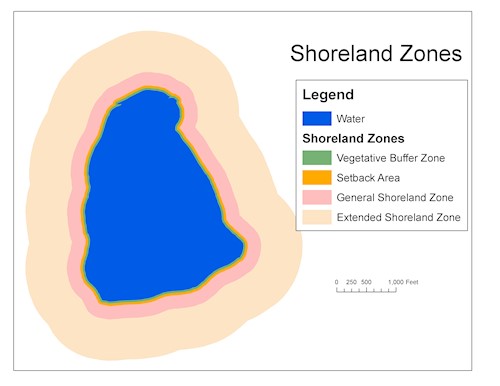 to determine what regulations apply.
In unincorporated areas, the county ordinance creates a series of rings or buffers around each waterway. Depending on how far your project is from the water, different regulations apply.
The closer to the water, the more protective the regulations become.
a. New lots must meet minimum lot size and width standards.
a. New lots must meet minimum lot size and width standards.
b. Shoreland erosion control permits are required before disturbing any land. Simplified applications are available for small projects.
c. Shoreland zoning permits are required before:
i. Building any new permanent or temporary structure.
ii. Adding on to, or expanding (vertically or horizontally) any existing structure.
iii. Making changes to any impervious surfaces (including buildings, pavement, patios, walkways, etc.). Impervious surfaces cannot exceed the current percentage of the lot, or 15%, whichever is greater.
d. Shoreland mitigation permits are required before covering between 15% and 30% of any lot with an impervious surface.
a. Shoreland mitigation permits are required before:
i. Building any new permanent or temporary structure.
ii. Adding on to, or expanding (vertically or horizontally) any existing structure.
a. No structures are permitted, except for boathouses, piers and walkways.
b. No permit is required for "routine maintenance" (including lawn mowing) of existing vegetation, as long as you do not disturb any ground, and do not remove any layer of existing vegetation. For example, selective pruning of trees would qualify as "routine maintenance," but removing whole trees would not.
c. Shoreland zoning permits are required before:
i. Removing existing vegetation to create a viewing and access corridor to get to the water.
ii. Building a stairway, walkway or railings, when needed to access the shore.
d. Shoreland mitigation permits are required for:
i. Removing any vegetation, except for viewing and access corridors and routine maintenance.
ii. Building a new, or adding onto an existing, boathouse.
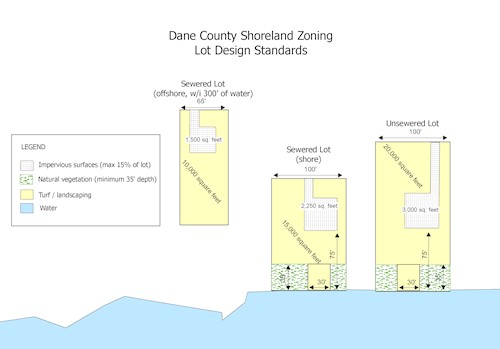 New lots in the shoreland zone must meet minimum lot widths and area standards, depending on where they are in relation to the shore and whether or not they are on public sewer. Buildings, with the exception of permitted boathouses and walkways, should be a minimum of 75 feet from the ordinary high water mark. The first 35 feet from the shore, except for viewing and access corridors, should be left in a natural state. If your project meets the lot design standards, you will need shoreland zoning permits and (in most cases) shoreland erosion control permits, but you will not need a shoreland mitigation permit.
State law requires counties to adopt mitigation standards that are proportional to the impact of development on water quality, fish and wildlife habitat and natural scenic beauty. In Dane County, mitigation standards include two components:
A shoreland mitigation permit allows for a wider variety of development options than is possible with only a shoreland zoning permit.
Dane County ordinance and state and federal law prohibit most construction, ditching or fill within wetland boundaries. In addition, the Dane County shoreland zoning ordinance requires that all new structures be at least 75 feet from the boundary of any wetland 2 acres or larger. The maps of the Wisconsin Wetland Inventory give a good general idea of the location of wetlands across the state. However, maps are no substitute for a field delineation to determine precise wetland boundaries. Please note that if you are proposing a project that is located close to a mapped wetland boundary, you will need a wetland delineation and a location survey to make sure wetland setbacks are met.
Yes, as long as the lot:
Shoreland zoning permits, shoreland mitigation permits and shoreland erosion control permits will apply to any new construction. New construction will have to meet all floodplain regulations, setbacks, wetland buffers, impervious surface limits, vegetative buffer zone protections or appropriate mitigation standards. Variances are not required unless physical limitations of the lot make it impossible to meet either site design or mitigation standards.
The county shoreland zoning ordinance makes special provisions for legal, nonconforming buildings and structures that were built before the ordinance went into effect.
County shoreland permits are not required for any of the following:
Note that depending on the type of work being done, town building or driveway permits and county sanitary permits may still apply. Additionally if the structure is located in the regulatory floodplain these projects may require a floodplain development permit.
Shoreland zoning permits are required before:
Shoreland mitigation permits are required before:
Shoreland erosion control permits are required before disturbing any ground, whether or not the work is associated with a nonconforming building or structure.
In most cases, no, as long as your property complies with a recently-approved farm conservation plan. Contact the Dane County Land Conservation Division to see if your farm plan is up to date.
Most shoreland projects will either meet the basic lot design standards, or can meet performance standards with simple, relatively inexpensive, mitigation practices. In rare cases, unique circumstances, such as extremely small or oddly shaped lots, may make it impossible to meet ordinance standards and still have a "reasonable use" of the property. If you have exhausted your mitigation options, and your project cannot be redesigned to comply with the ordinance, you may be eligible for a variance from the Dane County Board of Adjustment.
The Zoning Division of the Dane County Department of Planning and Development should be your first stop if you are thinking of doing work near the shore. County zoning staff can review your plans and let you know what permits, if any, you will need. If necessary, zoning staff may refer you to the Land and Water Resources Division for additional permits or reviews.